

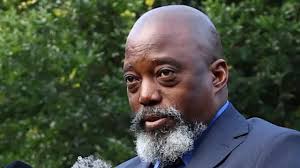
Former Democratic Republic of Congo president Joseph Kabila arrived in Goma on Sunday, entering the rebel-controlled city days after the Senate stripped him of immunity.
While the M23 rebellion has not formally declared him part of its ranks, the group’s spokesperson Willy Ngoma confirmed Kabila’s arrival and praised his visit to what they described as “liberated zones.”
Kabila’s choice to resurface in Goma — capital of North Kivu and a major hub under the control of the Rwanda-backed M23/AFC alliance — followed a week of legal and political upheaval.
The Senate lifted his immunity on Thursday, paving the way for military prosecutors to pursue treason and war crimes charges over his alleged support for the rebellion.
With arrest now a real possibility, Kabila, who was born in the eastern town of Hewa Bora in South Kivu, fled further east — deeper into territory held by the very rebels he is accused of aiding.
In a speech upon arrival, Kabila denounced what he described as the central government’s abandonment of eastern populations.
“These decisions and many others are suffocating you and making your life more precarious than ever,” he said, referring to Kinshasa’s move to disconnect local financial institutions from the national banking network and impose restrictions on movement.
He called for a “humanisation of living conditions” in the east and a return to governance that genuinely serves the Congolese people.
He urged state institutions — including the army and judiciary — to protect civilians and abandon what he characterised as partisan manipulation.
“Congo is worth more than the caricature given by its current leaders. Congo deserves better than a foreign policy of whining and begging," he said.
The former president outlined a 12-point plan for national recovery, calling for an end to dictatorship and war, the restoration of democracy and state authority, the protection of civil liberties, disarmament of militias, reconciliation of the population, regional dialogue, and the withdrawal of all foreign troops.
“Congolese problems need Congolese solutions,” he said.
Kabila’s eastern flight was foreshadowed by a defiant post on X on May 23, in which he wrote: “As a soldier, I swore to defend my country to the point of the ultimate sacrifice. I have remained faithful to this oath. I’m ready. I’ll play my part. Until the end.”
It was also the day he gave a scathing speech from an undisclosed location, blasting President Félix Tshisekedi’s administration for “populism, lies, discrimination, and impunity” and accusing it of institutionalising tribalism and undermining national cohesion.
He specifically attacked the Congolese justice system, accusing it of being “exploited for political ends” after the High Military Court brought charges against him.
“As for the justice system... it has completely abdicated its responsibilities,” he said, portraying the institutions of state as tools in the hands of what he labelled a dictatorship “desperately trying to survive against the current of history.”
Kabila’s political and personal return from exile was first hinted at in an April interview with Jeune Afrique, in which he said: “After six years of complete retreat, one year in exile, and in light of the escalating security crisis, I have decided to return to the DR Congo without delay.”
He had left the country quietly in December 2023 and had been residing in South Africa, where he enrolled in postgraduate studies at the University of Johannesburg.
He later said he suspended his studies in March 2025 “to make time for what’s happening back home.”
Kabila, now 53, is no ordinary rebel-linked figure.
He assumed the presidency on January 17, 2001, after the assassination of his father, President Laurent-Désiré Kabila. He was elected in 2006 and re-elected in 2011.
After completing his second term, he stepped down in January 2019 and handed over power to Félix Tshisekedi — a transition that many observers said preserved peace but planted the seeds of a bitter rivalry that continues to this day.
The pair’s alliance disintegrated in early 2020 over disagreements about judicial appointments and control of the electoral commission.
As Tshisekedi forged a new majority in parliament, he also increasingly blamed Kabila for the resurgence of M23 and the rebellion in the east. During the 2023 presidential campaign, Tshisekedi publicly accused Kabila of being the real power behind the Alliance Fleuve Congo (AFC), a rebel coalition that includes the M23.
“Joseph Kabila boycotted the election and is preparing an insurrection because he is the AFC,” Tshisekedi said at the time.
At the Munich Security Conference earlier this year, he went even further: “The real sponsor of the opposition that took up arms in complicity with Rwanda is hiding: it is Joseph Kabila.”
The government has yet to present evidence to support these claims.
Still, the former president’s journey back to the centre of power — or perhaps open confrontation — has been a long time coming.
Over the past year, Kabila held meetings with opposition leaders abroad, called on South Africa to re-evaluate its military support for Tshisekedi, and wrote opinion pieces criticising Kinshasa’s handling of governance and security.
In a February article for the Sunday Times, he accused Tshisekedi of trading the country’s mineral wealth for foreign military support while ignoring domestic grievances.
“To me, it’s not the right approach,” he wrote. “What interests me and what interests the Congolese people is how do we deal with the situation ourselves.”
Kabila’s recent moves have ignited speculation over whether he now intends to position himself as a parallel authority in the east or as a political alternative in a deeply divided nation.
But with no official announcement from M23, and no arrest yet executed by Kinshasa, the future path of DR Congo’s former leader remains tangled in uncertainty — and overshadowed by war.
